The Filth

Wanna go deeper with The Filth?
Here's the podcast episode with AstroCosmos.
 The Filth are a flexible faction whose commons mutate into terrific units to meet the challenge of whatever threat they face. Their strength comes from their flexibility along with their ability to capitalize on their opponent’s failure to clear their units from the board. 
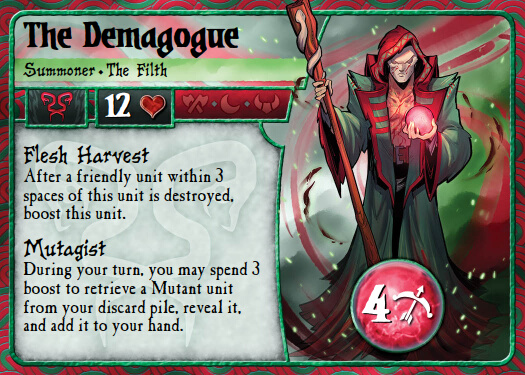
And even if the enemy does kill the Filth units, the Demagogue is more than happy to revel in the slaughter.
The Filth deck revolves around its Mutants. These limited units provide the Filth with more variety than any other deck. They boast some powerful abilities and stat lines. But they also come with unique costs. 
First, as there is only one copy of any mutant in the deck, you are restricted in your strategies during the early to mid game by your draw order. 
Second, mutants cannot be summoned normally: they must destroy a friendly unit to take their place. While this clears any wounds a mutated unit had suffered, it also means that every fresh mutant summoned from a gate costs an additional cultist. As a Filth player, it is imperative that you’re able to squeeze extra value from every friendly unit destroyed in order to achieve victory. Otherwise, you will find yourself quickly running out of cultists, cards and the ability to close out the game.
The Demagogue
The Demagogue is the lynchpin of your army. Sharing some similarities to the death-obsessed Fungal Dwarves, the Demagogue gains boosts every time a friendly unit within 3 spaces is destroyed. This includes the destruction as part of the summoning cost of the Filth mutants. As such, the Demagogue wants to be close to both his summoning spots and the frontline where his cultists and mutants wage their war. His 4 range strength is often a tempting attack to leverage. However, there are limited defensive tools available in the deck. And a wounded Demagogue becomes less effective in occupying this “middle space” to effectively harvest boosts. It’s important to recognise when and where the Demagogue can get in safe shots while minimising or eliminating the enemy’s ability to retaliate. 

Mutagist, however, is a powerful ability. For three boosts, you can reclaim a mutant from your discard pile. This allows recycling powerful mutants again and again. You begin with the generalist Tentacle Mutant in your starting setup and its reach is applicable in just about every matchup. Otherwise, you can bring back mutants that are strong against your opponent’s faction, like harrying Cave Goblins with constant Bursting and Spew Mutants to kill their low health commons. You can also convert boosts directly into magic. Since Mutagist can be done in any phase and any number of times, if you have an excess pool of boosts, you can reclaim and discard the same mutant to generate magic for your next turn. 

The bare minimum amount of magic the Demagogue wants to end the turn on is 2. This allows you to summon any common mutant you draw or bring back with Mutagist. The standard is 3 magic, as that can allow you to play a champion or two mutants with Volatile Flesh. However, 4 magic is ideal when possible as it allows two common mutant plays or a champion depending on your draw and how the opponent responds to your board. Higher magic simply opens up more options with 7 being the last important benchmark which will be covered later. 
Malignant Cultist
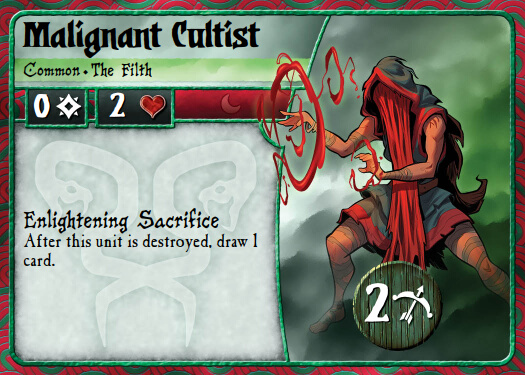
The cultists in the Filth deck may look unassuming but they are a vital resource just as much as the boost and magic pool. They are, in essence, a hard cap on the number of mutants you can play. At their core, every cultist that dies is a mutant that was not summoned. However, you cannot mutate every cultist in your deck. So it is important that you get as much value from your dead cultists as possible. All of them are 0 cost, so the only restriction you have with playing them is summoning spots. Generally, you will want to get your cultists to the board as quickly as possible so you can draw more cards and get to your important mutants faster. 
Try to keep them within the 3 range of the Demagogue’s Flesh Harvest so you can pool more boosts. So even if you lose them, you’re still getting more from them. Malignant Cultist specifically helps you dig a little quicker for your mutations as well as add an important range poke option. But be careful when using them to summon fresh mutants as the draw will prevent you from undoing your actions. Generally speaking, it is best to mutate a Malignant early as the extra draw may change your plan for the turn.
Fetid Cultist
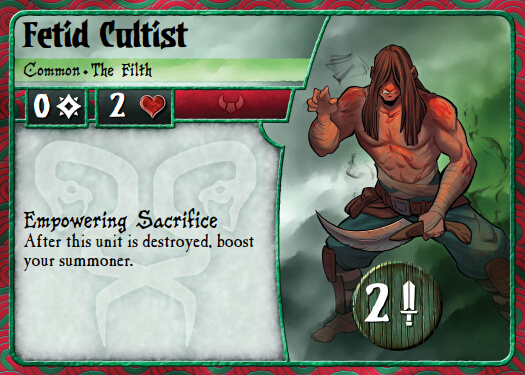
Fetid Cultists are quite useful for their ability to get you two thirds of the way to a Mutagist activation. Their melee attack is more helpful for contesting your opponent’s units though they will be harder to keep within Flesh Harvest range. Forward gates assist with positioning. Not only do gates placed on your opponent’s side of the board provide the Demagogue with cover but their summoning spots allow your Fetid Cultists and melee mutants to reach their targets. A stray Fetid Cultist can still be useful as their death will generate one boost regardless of where they die so they can perform suicide missions if the Demagogue is just shy of another Mutagist use.
Anointed Cultist
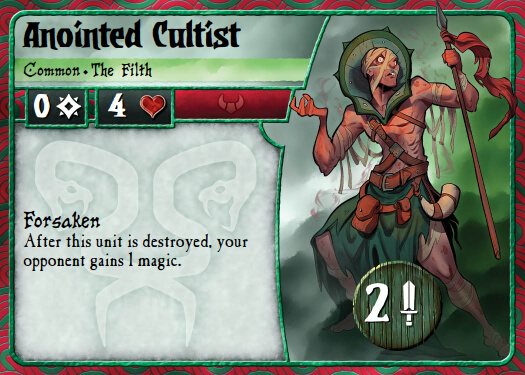
These cultists are very strong. But they also come with a significant drawback. Four health will generally require two attacks to kill and, if you position them properly, can often have good odds to survive an attack to be mutated later. But do not underestimate the boon an extra magic from Forsaken can be for your opponent. These units will be high priorities for your enemy. 
If you can’t limit the attacks they will receive, they are often better discarded for magic than feeding your opponent extra resources. That said, they are a significant threat when they hit the board to assist your mutants and Abomination as you can quickly flood the field with multiple high health, high priority targets which your opponent may struggle to clear. They are also one of the worst cultists to use as a fresh mutant summon from a gate as it just gives the enemy a free magic. On the flip side, they pair exceptionally with Shield of the Hopeful, becoming nigh unkillable. Skillful use of Anointed Cultists will often lend the Filth a significant advantage in a match.
Tentacle Mutant
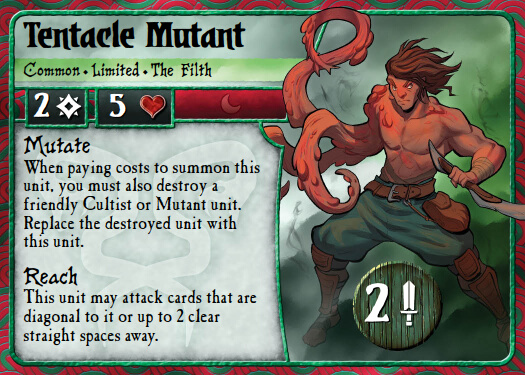
Mutants are what make the Filth a scary faction. And the Demagogue starts with one of the most generally useful mutants on the board. Tentacle has a very desirable 5 health which can be difficult for many factions to take down in a turn. A wounded Tentacle is a prime candidate to receive another mutation, especially since it’ll often occupy a forward position on the board. Reach helps it to hit priority targets or bypass certain frustrating abilities like Spectral Conclave’s Depart. In many games, Tentacle may be the only mutant you have for the entire early game if your other mutants are buried in your deck. So learning to position it well will have far-reaching benefits.
Spew Mutant
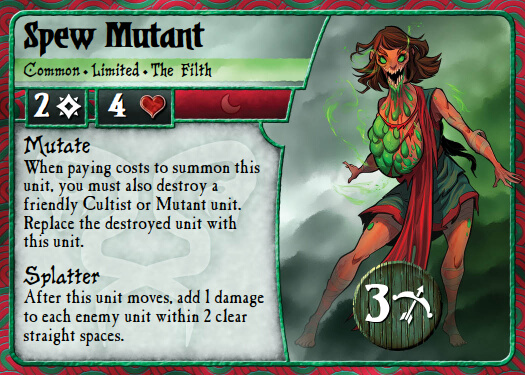
Every mutant is good but typically excels in specific situations. Spew is one of two truly ranged Mutants which can be useful on its own. However, it is important to remember that Splatter has a shorter range than its attack at 2 spaces. So Spew is best on crowded boards where you can get multiple Splatter hits. It is especially helpful for clearing 1 health blockers so enemy units behind can be exposed.
Bursting Mutant
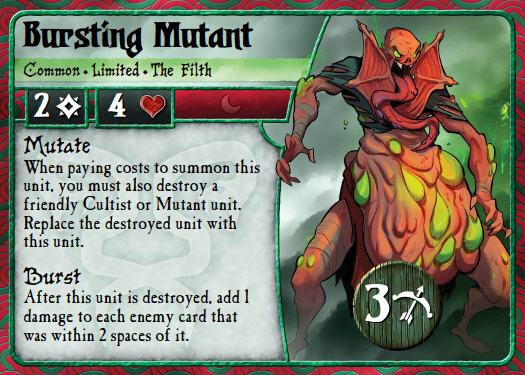
Bursting shares a number of similarities with Spew. It is also ranged and has an ability that only hits 2 spaces. As such, it’s worse than Spew in a straight up range battle since your opponent could kill it at maximum range in which case, Bursting is essentially a unit with no ability. Consequently, it also wants to see play on busy boards with lots of targets. The downside of Bursting is that the opponent has some control over what will get hit. The best setup for Bursting is when you are deep into the enemy’s territory and your opponent doesn’t have a lot of options to maneuver out of the way. 
Position Bursting Mutants near wounded enemy gates as most factions can’t move their structures. Great Bursting games can see it explode for upwards of 4 or more damage on enemy cards so it generally has a higher ceiling than Spew.
Horror Mutant
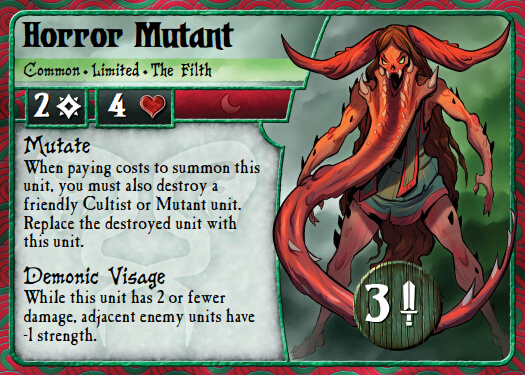
 Horror is one of the few defensive tools in the Filth deck. It is impervious to 1 strength melee hits (as long as it’s not on its last point of health) and can extend that protection to a nearby unit with proper positioning. It is also the highest strength mutant in the deck so is a prime target for Volatile Flesh. However, it is the only mutant that lacks any measure of reach so it can be hard to get it into position and on valuable targets without mutating it over an existing unit. 
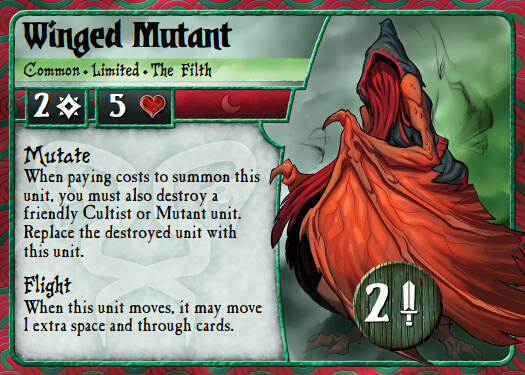
Winged Mutant
 Winged is a card that is pure threat. On its own, it’s not too scary of a unit. Two melee dice on a flying unit isn’t bad but its Flight will typically take it outside of Flesh Harvest’s range. However, the 5 health is a difficult amount to clear in a turn. And if Winged survives, it can turn into a number of even worse mutations. It also has great combo potential with Volatile Flesh as it can transform into a 5 melee bomb that can really chew into the opposing summoner. 
Keeping Winged off the table is an interesting tactic, so the opponent doesn’t know where or when it will strike. If drawn early, you will typically discard it for magic knowing it can be pulled out with Mutagist when needed. In this way, your opponent always needs to play around the potential for Winged to hit the board. However, as an enabler, it is rarely a target for Volatile Flesh. 
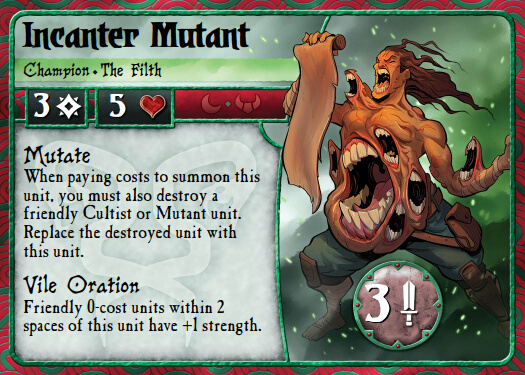
Incanter Mutant
Incanter is possibly the most niche of the mutants. As a champion, it is afforded some protection against common only abilities. However, Vile Oration is only valuable when you have lots of cultists on the board. Cultists, however, are very fragile. And arranging your cultists to be in range of Incanter and Flesh Harvest while also hitting valuable targets can be a cumbersome proposition.
However, if you have several Anointed or Shield of the Hopeful, you can get several turns of very powerful cultists that can contest your opponent’s expensive commons. 
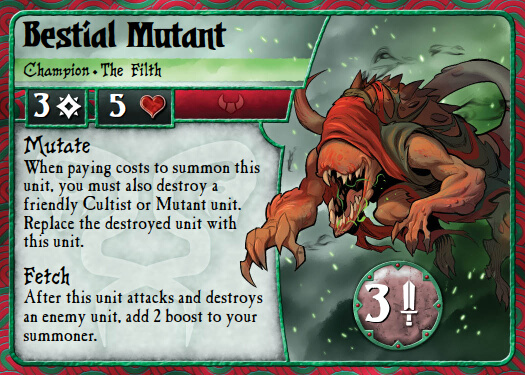
Bestial Mutant
 One of the best mutants, Bestial enables the Demagogue to do more of what he wants. Every kill it gets not only generates you bounty but also a Fetid Cultist worth of boosts. A Bestial that lasts multiple turns can create a staggering amount of resources for the Filth. As such, it is a very high priority for the opponent to destroy. Using the 0 cost cultists and other mutants to protect Bestial is important to getting the most out of it. Three magic is a lot to spend if it just dies the first turn it is summoned.
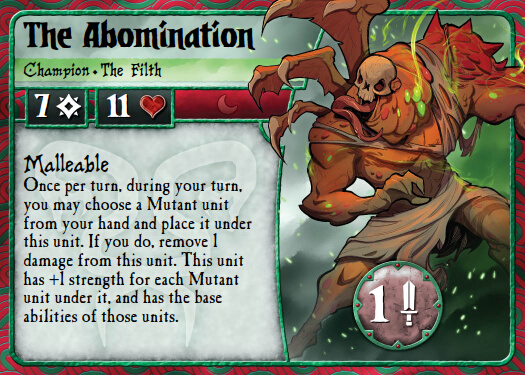
The Abomination
 No discussion of the Filth is complete without mentioning their biggest terror. The Abomination is a centerpiece champion which opponents most always consider when facing the Demagogue. It is not cheap at 7 magic cost. On top of that, the Abomination utilizes your other mutants to gain additional strength, heal and the ability of the mutant tucked under it. This bumps up the cost of the champion as, at a bare minimum, it needs two mutants under it to be truly effective. This locks out that mutant from being summoned elsewhere and typically costs more boosts to get the desired mutant back from the discard. While the ceiling for Abomination is quite frightful, many Filth games are lost by an opponent ignoring the Abomination and finishing the Demagogue off before the big monster closes out the match.

Thus, it falls on the Filth player to build up a powerful Abomination but not needlessly lose it to enemy faction combos. 

A standard Abomination build includes Tentacle, Winged and Spew beneath it giving you a 4 strength, three movement melee unit that can fly over cards, damage those it lands near and attack two spaces or diagonally. This can be a nightmare for low health enemy summoners to escape. It does take three turns to form this Abomination and you might find it difficult to leverage Abomination during that time. 

Given Abomination’s high cost, it can also be challenging to protect it while you assemble its pieces. You might lack the boosts or magic to mutate other mutants out and require throwing cultists to the board to buy you time. As such, I often use Incanter as the first malleable unit beneath Abomination. This allows it to provide those cultists with the Vile Oration buff while you gather the other mutations. Bestial is another good mutant to get under the Abomination as the Abomination can get easier kills on higher health targets, thus paying for its own future upgrades. However, this generally requires at least two other mutants empowering the Abomination to be effective. 

Some other mutants are less useful beneath Abomination too. Bursting’s ability only triggers on its destruction but the Abomination is a primary win condition for the Filth. If it is destroyed, you'll likely lose. Furthermore, while Horror can protect the Abomination in those crucial early turns, once four or more damage is on Abomination, it loses the effect of Demonic Visage and the heal from further malleable triggers probably won't bring it back. These two mutants generally work better if they're used as support for a highly mutated Abomination terrorising the battlefield.

Volatile Flesh
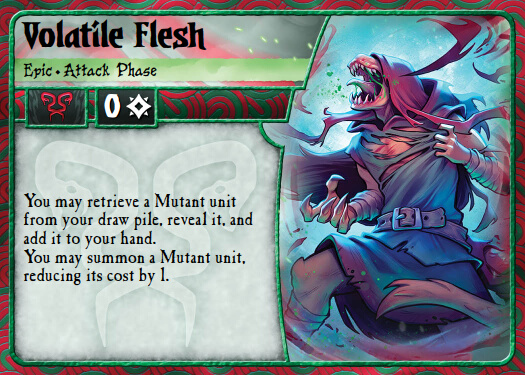
The Filth’s epic event is definitely one you want to play. It is good at all stages of the game. An early draw allows you to immediately pull out your most vital mutation from the deck. The magic discount means you can get 2 mutations while starting a turn at 3 magic. 
Finally, the summon during the Attack Phase means that you can attack with a unit, play Volatile Flesh and attack with the new mutant from the same spot. Generally, holding one Volatile for this double tap against an enemy summoner is important to put the opponent on the back foot or even to close out a game. While the first Volatile Flesh is likely going to be spent to smooth your economy and fetch a useful card, the second should be held until an opening against a priority target presents itself. 
Shield of the Hopeful
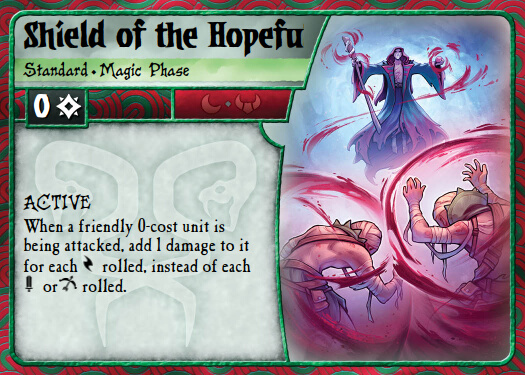
 A hidden strength with the Filth deck is that it possesses strong but situational events. Their common events generally aren't important enough to hold in your hand as drawing through your deck to find your mutants is more valuable. This makes discard decisions easier as, if the event isn't useful this turn, you can typically discard it without worry. 

Shield of the Hopeful demonstrates this perfectly. It is powerful but unreliable, providing great odds that your cultists can survive a round of combat with the enemy - assuming they have no auto-damage to bypass it. However, if you don't have a lot of cultists on the board or they're not in a position to take the hit in place of your mutants, summoner and gates, then it's better converted to magic to pay for your next mutant.
Horrify
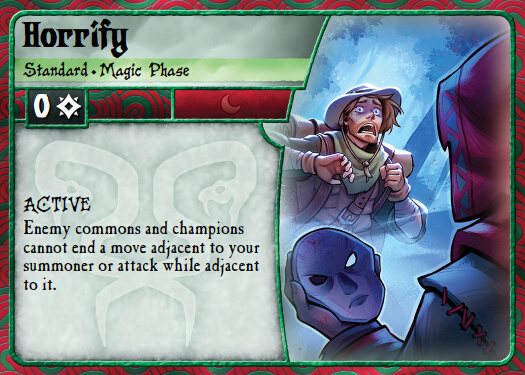
Another great event in the right situations, Horrify is another of the limited defensive options the Demagogue possesses. It does not, however, stop ranged attacks or enemy summoners. Against melee factions or strong melee combos, it can be great. Or if the Demagogue has pushed forward and only has adjacent spaces open from where he can be attacked. Not only does this protect the Demagogue, but with clever positioning it can also prevent attacks against your other units. On the other hand, plenty of factions can still work around Horrify and pile a whole bunch of damage on a careless Demagogue through force or shoot through effects. 
Zeal
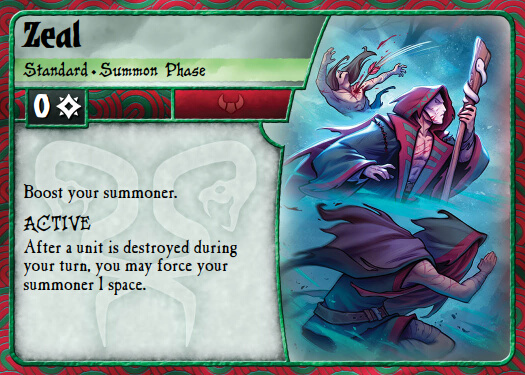
 Zeal can open up a lot of surprising tricks for the Filth. At its base level, Zeal allows Demagogue to attack and slip behind cover - assuming you’re able to secure a kill after the Demagogue’s attack. At its high end, the Demagogue can flash across the board through multiple mutations, incidental kills from direct damage and the destruction of enemy units in the attack phase. You can catch opponents off guard who thought their low life summoner was safe and secure victory through a zealous charge.

The 1 boost is not to be underestimated either. With experience, you can bluff opponents into thinking they have a safe turn from future mutations by holding Zeal while at 2 boost. This can allow you to pull out a timely mutation while luring your opponent into a dangerous position. 
 The Filth is a powerful, brawling deck that wants to close into the middle of the board and get up in the enemy’s face. You’ll want to present the opponent with a lot of high health, high priority targets so that their misses can be neutralised through fresh mutant summons. All the while, you will be digging rapidly through your deck as you play your cultists and events or discard what is not needed now to save for the Abomination. But it is not a deck that can tarry, as each mutation eats away at your own resources. If games draw out too long, the Filth can run out of steam and careless uses of Anointed cultists can feed their enemies the magic necessary to destroy their expensive units. Overzealousness can spell an early defeat too, for a crippled Demagogue can be forced out of good Flesh Harvest positions and get starved of the boosts necessary to keep the deadliest threats from returning to the field.

But if the Filth can mount a strong offense and keep the pressure on their enemies, then they can stifle their opponents board and overrun them with ghastly monsters to claim delicious victory.
Copyrights for the Summoner Wars logo and art belong to Plaid Hat Games, used herein with their express permission.
Search for a card...
of